Intellectual Freedom
Mary C. Moore Public Library takes intellectual freedom very seriously. The principles of intellectual freedom, as defined in the Universal Declaration of Human Rights, include the interlocking freedoms to hold opinions and to seek, receive and impart information and ideas through any media and regardless of frontiers (via the Canadian Federation of Library Associations).
As public libraries, we are providers of information, and are not in the position to make judgments or restrictions on what our borrowers read. We encourage curiosity, engagement, continuous learning and the development of knowledge that is unique to each reader. Evaluating, consuming, processing, and enjoying information, and the formulation of knowledge are key to developing critical, imaginative thinkers that in turn create and contribute to dynamic communities. Access to a wide range of viewpoints, opinions and perspectives is essential to intellectual freedom. Limiting or withholding information in the form of restrictions, censorship or suppression is damaging to individuals, communities, and democracy. We uphold the right of individuals to make their own reading choices based on their own information needs, interests, beliefs and principles. We also support parents, guardians and caregivers of all kinds in making their own choices as to the kinds of information they feel is appropriate for their own children or vulnerable adults in their care
Bill 28
“All persons in Canada have a fundamental right, subject only to the Constitution and the law, to have access to the full range of knowledge, imagination, ideas, and opinion, and to express their thoughts publicly. Only the courts may abridge free expression rights in Canada” (via the Canadian Federation of Library Associations).
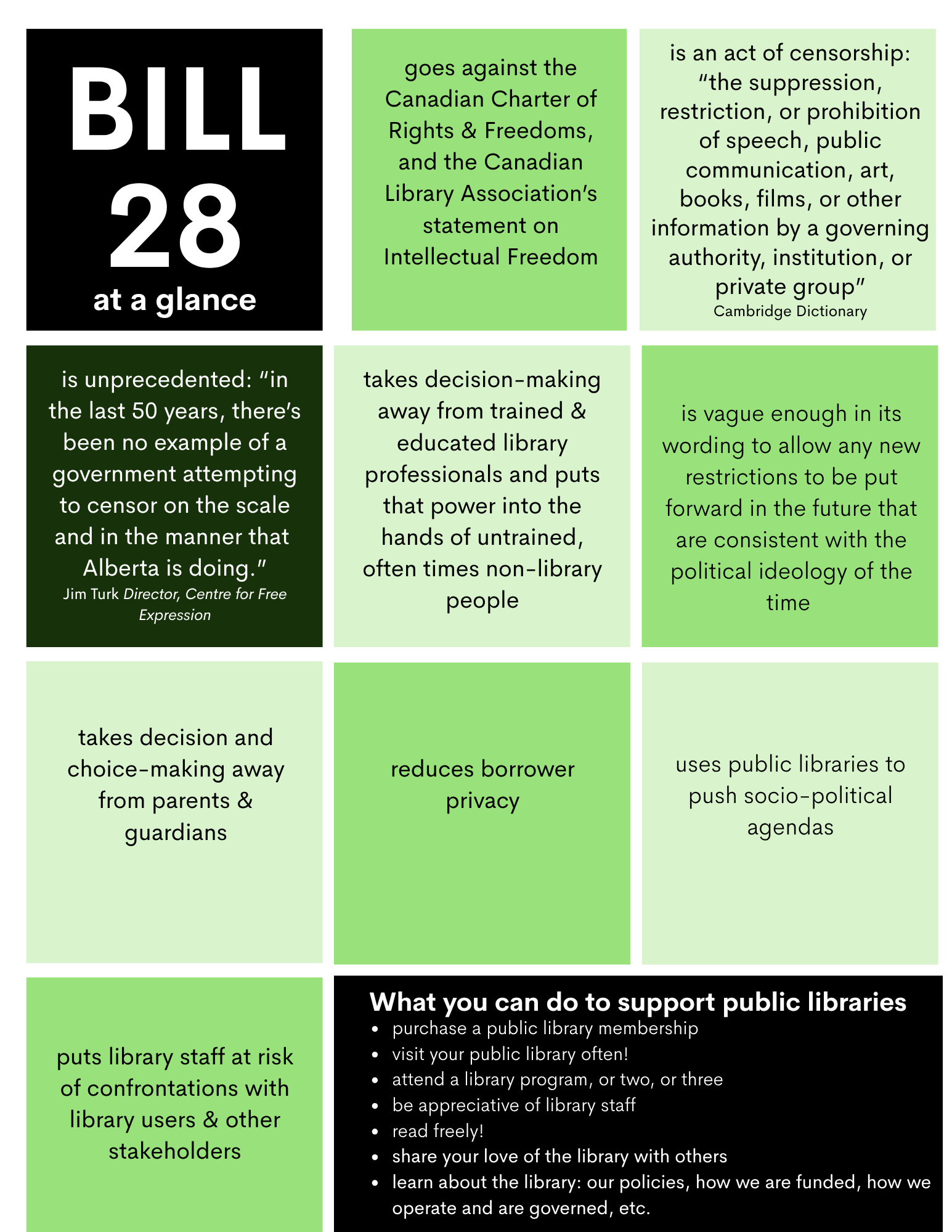
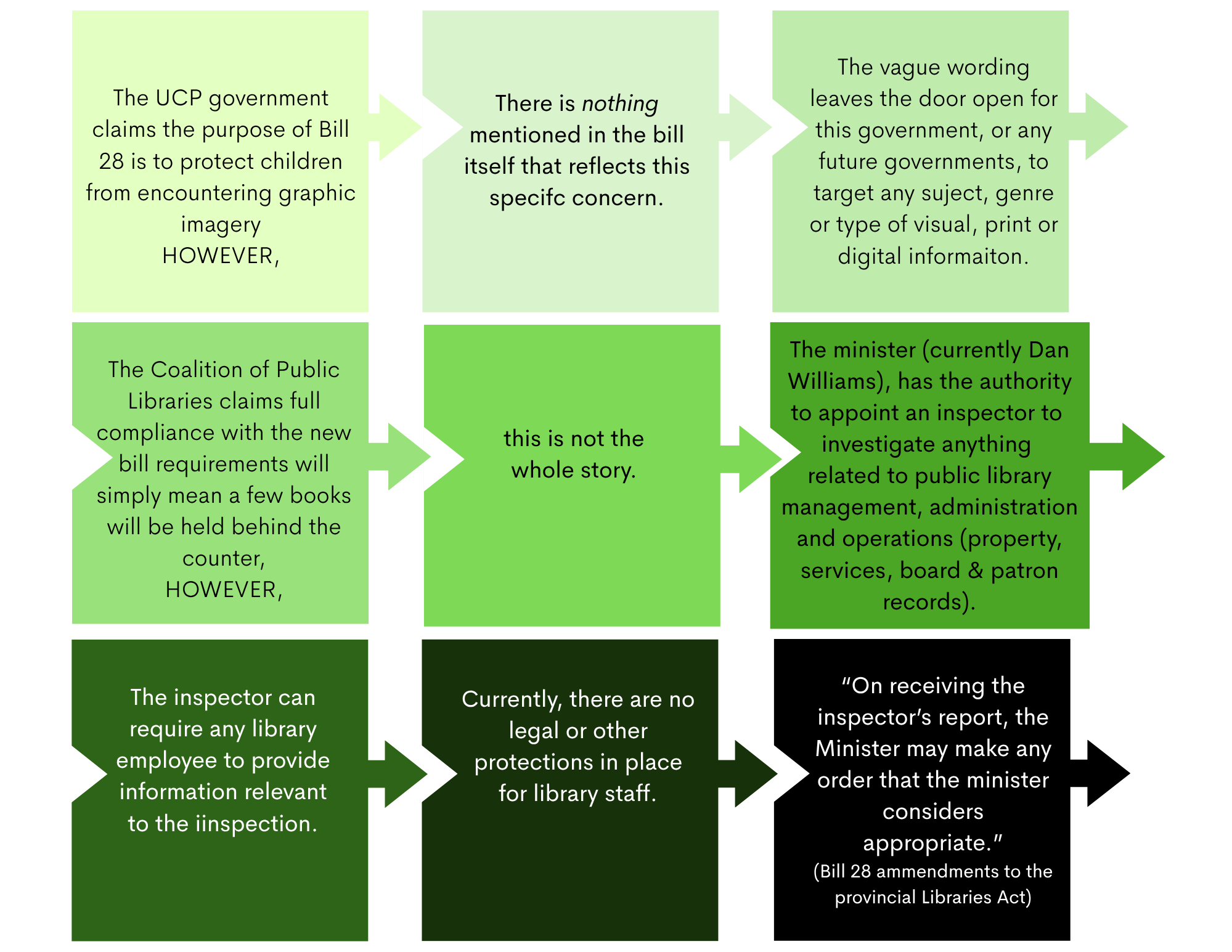
Recently, the UCP government of Alberta has made amendments to the provincial Libraries Act as part of Bill 28, which will impact library and borrower services, as well as the intellectual freedom of public library borrowers. While the bill aims to protect children from encountering sexually explicit visual material, it is important to know that public libraries do not (and cannot, under Canadian laws) have pornography in their collections. Public libraries already have policies and collection organization schemes in place that separate adult from children’s materials. Furthermore, it is the role of parents and guardians to choose appropriate materials for their children, and to be aware of where their children are in the library’s physical spaces at all times.
We encourage all public library users, and anyone who values their intellectual freedom, to learn about the implications of the new bill:
Read the Library Association of Alberta’s position on risks Bill 28 poses
Read all about Bill 28 and the work of the Coalition for Alberta (CAP) Libraries
Follow the Centre for Free Expression’s blog featuring updates on the bill